Questions for Riverfronts in Small Cities
Riverfronts in smaller Indian cities can widen access, support livelihoods and bring people back to the river, and some are already doing so. This commentary draws on reports from across the country to offer seven questions residents can ask early, so a riverfront stays usable, inclusive and cared for once it opens.

Rivers are important to cities, supporting local livelihoods, cultural practices and ecosystems while offering space for recreation and public life. The Sabarmati Riverfront in Ahmedabad has influenced riverfront development across India. But can an approach developed for a large city work equally well in smaller cities, where river conditions, relationship of people with the river and local needs differ?
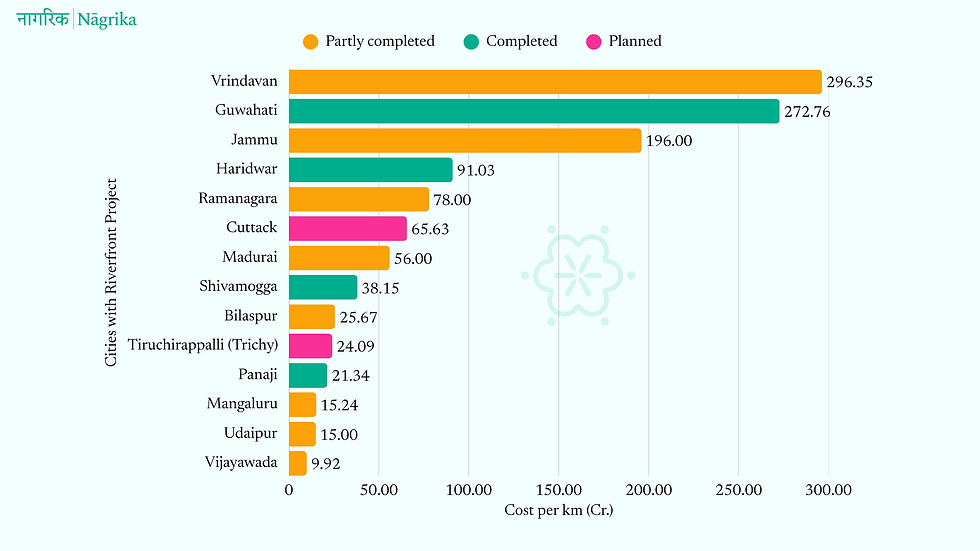
Smaller cities, too, are investing in riverfronts, with some projects bringing visible benefits. In Guwahati, the Brahmaputra Riverfront’s new park has boosted footfall and sales for nearby cafés, while Panaji’s Mandovi riverfront walkway has become a popular recreational space, including for elderly and wheelchair-using residents. Yet reports from smaller cities also highlight wider concerns.
This piece looks at five things reports from various cities keep referring to, and ends with seven questions that residents can ask.
What are Smaller Cities Telling Us to Ask?
Will the project be completed, and managed as promised?
In Rajamahendravaram, Andhra Pradesh, the Godavari Riverfront was only 30–40% complete by its March 2026 deadline. In Mangaluru, Karnataka, unfinished sections delayed the Netravati Riverfront Promenade’s opening and restricted public access. In Karimnagar, Telangana, funding and land-acquisition bottlenecks prompted officials to fast-track the Manair Riverfront project.
What happens after the riverfront opens?
Poor post-construction management can undermine riverfronts after inauguration, leaving public spaces deserted or poorly maintained. In Shivamogga, Karnataka, the Tunga Riverfront was reported to be largely deserted in January 2025 because no agency had taken responsibility for managing its facilities and maintaining the grounds. In Vijayawada, Andhra Pradesh, a June 2026 report described dry lawns, withering plants and damaged play equipment at Krishnalanka Riverfront Park. At Simaria Ganga Riverfront in Bihar, a July 2026 report described accumulated soil on the steps and persistent garbage despite cleaning staff being deployed. Additional cleaning and beautification efforts followed, although their long-term effectiveness remains unclear. In Guwahati, Assam, the newly inaugurated Brahmaputra Riverfront was littered with waste within hours of opening, while subsequent reporting highlighted the challenges of maintaining cleanliness and facilities amid heavy public use.
What might change for the river itself?
In Rajamahendravaram, removing old embankments left parts of the Godavari riverbank vulnerable to flooding. In Badrinath, Uttarakhand, Alaknanda Riverfront work was halted for technical study over potential effects on Tapt Kund’s natural hot-water source. In Salem, Tamil Nadu, farmers alleged that beautification works damaged a check dam and disrupted downstream water flows. In Vrindavan, Uttar Pradesh, the Supreme Court halted Yamuna Riverfront construction over concerns about narrowing the channel and affecting ecological flows. In Udaipur, Rajasthan, concerns that concretising the Ayad River’s bed and floodplain could restrict flow and increase flood risks led to NGT proceedings. In Guwahati, Assam, residents opposed mature tree removal during Brahmaputra Riverfront redevelopment, citing lost green cover and shade.
What might change for people who depend on the river?
Riverfront projects can disrupt livelihoods, restrict access and affect cultural heritage. In Mangaluru, Karnataka, boatyard owners and fishnet producers opposed the Netravati Riverfront project, fearing loss of riverbank access and livelihoods. In Haridwar, Uttarakhand, traders feared displacement under the proposed Ganga Corridor. In Ayodhya, Uttar Pradesh, vendors at Ram Ki Paidi feared losing their livelihoods, while a priest criticised changes obscuring historic landmarks under the redevelopment project. In Vrindavan, Uttar Pradesh, a temple organisation objected to riverfront construction near Keshi Ghat over concerns about the historic ghats’ identity). In Tiruchirappalli, Tamil Nadu, residents raised concerns about access, parking and bathing facilities for religious rituals under the proposed Cauvery Riverfront project, some said they were unaware of the public hearing.
In Shivamogga, Karnataka, the Tunga Riverfront was reported to be largely deserted in January 2025 because no agency had taken responsibility for managing its facilities and maintaining the grounds.
Will a new riverfront mean a healthier river?
Riverfront development does not necessarily resolve pollution or account for changing river conditions. In Bilaspur, Chhattisgarh, sewage continued threatening the Arpa River despite existing treatment facilities, prompting High Court scrutiny. In Tiruppur, Tamil Nadu, sewage continued entering the Noyyal River at multiple points, leaving its water unfit for drinking despite treatment infrastructure. At Simaria Ganga Riverfront in Bihar, the river channel was reported to be 40–50 metres from the constructed steps, reducing their usefulness to visitors. In Jammu, residents questioned whether Tawi Riverfront structures contributed to flood risks after the August 2025 floods damaged homes and religious structures.
What can residents ask of a riverfront project that is underway or may come up in their city?
The examples above do not tell us whether a proposed riverfront in another city will succeed or fail. Done well, a riverfront can widen access, as Panaji’s walkway has for elderly and wheelchair-using residents. What the examples do show is why residents should look beyond the design that is promised: to how the project is delivered, how it is kept up, and how it fits the river and the people who depend on it. These questions need answers specific to each city and river. Asking them early can help residents take part in decisions about a riverfront that remains usable, inclusive and cared for once it opens. Asking them early can help residents take part in decisions about a riverfront that remains usable, inclusive and cared for, once it opens.
Delivery: Will it be finished, and on time?
Are funding, land and approvals in place, and what happens to the promised benefits if the work runs late or stops partway?
Upkeep: Who looks after it once it opens?
Which agency will maintain the riverfront, and are its responsibilities, staff and long-term budget in place?
The River: What happens to the river itself?
Does the design allow for seasonal flows, flooding, erosion and floodplains without harming the river’s ecology, and are the studies behind this open to the public?
People: Who loses or keeps access?
Will existing users, such as fishers, boat operators, vendors and bathers, keep their access to the bank and their livelihoods? Will historic ghats, sacred sites and local traditions be protected, with the community involved in decisions?
Safety and inclusion: Can everyone use it safely?
Can people of all ages and abilities use the space? Are accessible facilities, women’s safety and emergency access planned?
River health: Does it clean the river or only the bank?
Will the project deal with sewage, waste and pollution, or mainly develop the riverbank?
Accountability: Can residents see and follow it?
Can residents see the plans, raise concerns, and track whether the promised benefits are delivered?

What Could a Citizen-Sensitive Small-City Riverfront Model Look Like?
One proposal that starts by mapping existing users is the June 2026 report on Ramprasad Ghat in Halisahar, West Bengal, prepared for the municipality by IIT Kharagpur’s Centre of Excellence in Urban Planning and Design. It documents who uses the ghat and when (bathers, fishers, vendors and priests), states that no existing users will be displaced, and treats a committed municipal maintenance allocation and a management committee as conditions for success.. It covers a ghat of about 25 metres in a town within the Kolkata metropolitan area. It proposes improving accessibility and public facilities while preserving cultural heritage and accommodating existing users. Environmental measures include better waste collection and drainage, permeable surfaces, and constructed wetlands to filter runoff.
The proposal is not yet a proven success, and its implementation and long-term maintenance remain to be assessed. However, it illustrates an approach that starts with the site's needs rather than imposing a standard design. Ultimately, each city's riverfront should reflect its river, residents and capacity to sustain it.
Research Team: Harsh Sharma
Comments