Mapping Knowledge Gaps: How Wikipedia Represents India's Small Cities
Updated: Aug 15
A look at the knowledge gaps on Wikipedia pages of India’s smaller cities: examining what is present, what is missing, and how we can collectively build stronger local knowledge infrastructure.

Wikipedia shapes how people understand cities
If you were to come across the name of a city that you have not heard of before and you were to search for an unfamiliar city, the default starting point is Wikipedia. Even AI models draw information from them. These pages play a significant role in providing basic information to people with varied interests and expertise - common citizens, students, researchers and tourists. With missing data, often one does not get a holistic picture of the city. Since Wikipedia is often an introductory educational resource for both general readers and students, more comprehensive information would provide a better understanding of these cities. Wikipedia pages for Metropolitan cities reveal a more balanced representation of information in various sections of the page.
Evaluating how our smaller cities are represented
In July 2026, Nāgrika evaluated 35 smaller city pages on Wikipedia against 15 urban information indicators. The 35 cities were picked based on Wikipedia's own categorisation, these small city pages hold an important priority rating despite currently sitting at a C-class. The 15 indicators against which we measured quality included the physical identity (geography, area, transport), history, economy and culture, and municipal governance (legislation, departments, officials, wards/zones, etc.) to understand how comprehensively Wikipedia represents small Indian cities. These indicators were analyzed in the form of two separate groups. One included the non-governance related indicators like city history, geography, transportation etc. The other included governance indicators such as city government history, political and administrative heads, legislative framework, municipal departments and administrative units.
We based our assessment on the completeness and quality of information of these indicators. The two assessments identify two distinct forms of information shortage. A coverage gap occurs when publicly available information is completely absent from a page. A quality gap occurs when information exists but is outdated, inadequately detailed or incomplete. This distinction is important because improving city pages requires more than adding missing sections; existing content must also be examined for accuracy, completeness and currency.
We found that there is a visible lack of information for specific sections available on Wikipedia for small city pages. The pages contain good quality information on physical features such as location, their historical and cultural background as well as geographical features. However, information on governance and city government is largely missing.
Wikipedia city pages we examined | ||||
Agartala | Aizawl | Ajmer | Aurangabad | Bardhaman |
Bhavnagar | Bhilai | Bilaspur, Chhattisgarh | Bodh Gaya | Bongaigaon |
Brahmapur, Odisha | Dibrugarh | Durgapur | Firozabad | Haldia |
Howrah | Hubli | Imphal | Itanagar | Jodhpur |
Jorhat | Kadapa | Kannauj | Kanpur | Karnal |
Kohima | Kukatpally | Ludhiana | Margao | Mohali |
Mormugao | Mysore | Nanded | New Town, Kolkata | Port Blair |
There is a visible lack of information for specific sections available on Wikipedia for small city pages. Even artificial intelligence models draw on Wikipedia ot build their answers.
Small Indian City Pages Suffer Informational Imbalances on Wikipedia
COVERAGE GAP
Physical, Historical, and Transit Data Dominates City Entries
Throughout the 35 city pages, transportation was the most consistently documented data point, appearing on 91% of them and was backed up by citations from government documents, transport authorities, and reliable media reports. Of the 35, three cities, namely, Bardhaman, Aizawl, Mohali had insufficiently cited transportation information and relied on hyperlinks to other Wikipedia pages rather than appropriate references. Although such information may be factually correct, inadequate sourcing reduces its credibility for academic and formal use.
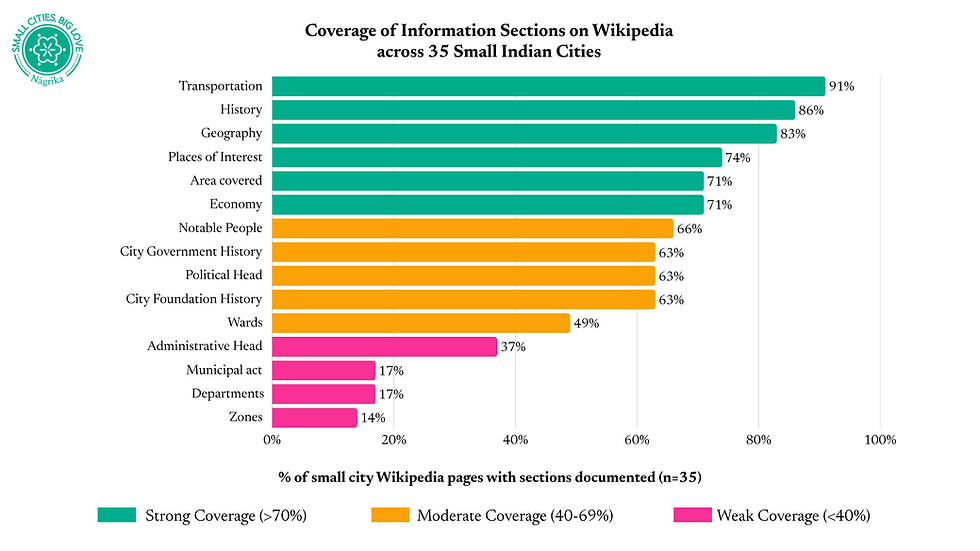
History, economy, and places of interest were well-documented sections across most pages containing substantial information supported by books, government reports, academic publications, travel guides and credible online sources. While in general there was information available some cities still had missing sections or lacking citations for the History pages. Even though Bongaigaon, Dibrugarh, Itanagar, have a rich history with medieval dynasties such as Ahoms, Sutiyas and their subsequent treaties or clashes and handover to the British, there is little written about it, in these sections.
Geography, although among the better-represented categories, also has limitations. Although 83% of pages have sections on it, only 31% of them have adequate coverage on topography, landforms, soil, vegetation and other physical features, instead of focusing primarily on climate. 18 pages have geography sections but with insufficient information, mostly pertaining only to rainfall and temperature data.
Even a city as historically and religiously significant as Bodh Gaya, a UNESCO World Heritage Site since 2002, lacks dedicated sections on both its economy and heritage status. It has experienced economic growth through the informal sector, tourism, hotels, travel agencies, infrastructure development and foreign exchange inflow.
Municipal Governance and Administrative Structures Remain Critically Underrepresented
Governance was the least represented domain across the 35 small city Wikipedia pages. Key data on municipal legislation, departments, officials, and administrative units were absent or outdated, obscuring the institutional backbone that oversees local infrastructure and essential civic services such as waste management, water supply, sanitation and other public infrastructure.
Importantly, these details are available through municipal and district websites, official gazettes, government notifications and local news. In fact, 83% of the assessed pages made no mention of the legislation under which their city governments function, despite this information being publicly available. The gap therefore reflects incomplete editorial coverage and maintenance rather than a lack of sources.
The scale of the problem is evident in individual city pages. Bodh Gaya had 12 of the 15 indicators missing and contained no information on its municipal administration despite being governed by a separate Nagar Parishad. Itanagar and Karnal each had 10 indicators missing, while Kukatpally and Mormugao each had 12. Here, governance information was almost entirely absent, while other aspects of the cities were also underdeveloped.
What makes some information more available than others?
The reasons for information being missing could be manifold, from the lack of reliable sources available to update Wikipedia pages, the lack of a systematic audit of what is missing and what can be added, the lack of a citizen champion to actually convert the available information to the Wikipedia pages or sometimes the contestation of the content which results in the removal of sections.
It is possible that since some data is easily available which makes it easier to fill out on the Wikipedia pages. There are regular publications of government reports, infrastructure announcements, and transportation-related news available from verifiable sources. One reason could be that these subjects are relatively stable over time and require less frequent updating and once updated can remain on the pages without much challenge.
Maintaining governance information is uniquely challenging because local leadership and ward boundaries change frequently. Editors must regularly verify data across multiple sources—since even municipal websites often lag behind official updates—to prevent Wikipedia entries from displaying outdated or missing information.
If edits and regular updates are maintained on the small city Wikipedia pages, it can emerge as an important comparative research tool for researchers, RTI filers, and policy writers for cross-city comparison.
QUALITY GAP
Presence Does Not Equal Precision: Evaluating the Quality and Currency of Existing Data
Beyond identifying the availability of data indicators, there is a need for a deeper level of assessment to evaluate the quality and reliability of information that is already present across the 35 small city Wikipedia pages. The existing information was classified into three categories - available data, sufficient data and incomplete or outdated data.

The content written on Wikipedia on indicators like geography and economy have the highest percentage of incomplete information although their representation as sections is high across these pages. This is an editorial maintenance issue that needs to be addressed to increase the reliability of these pages. These, once edited with thorough revisions and citation, would remain static for long periods and increase the currency of information already available.

Governance presents a more complex pattern. Information on political and administrative heads and administrative units was frequently incomplete or outdated, reflecting the need for regular updating (see Figure 3). Conversely, city government history and municipal legislation are comparatively static and would require less frequent revisions once accurately documented. The distinction is therefore between information that remains stable after initial inclusion and information that requires continuing verification.
How can citizen editors improve their city’s representation online?
Starting by first being curious and committed to increasing knowledge about one's city.
Wikipedia is an open source platform where anybody can update information. Based on our research some of the areas where citizens and/or wikipedia editors can contribute to strengthen their cities voice can be the following:
Add, verify and substantiate basic information about the city where it is missing. Prioritize information on municipal history and governance as a core section of every city Wikipedia page, as much as transportation, history, and geography.
Add information from official government documents: The editors can refer to official state-level gazettes, regional government notifications, district portals, and local news outlets rather than relying solely on major national media or official municipal websites (which are often outdated or slow to update).
The data regarding governance can be verified and checked from multiple sources, especially most recent sources such as newspaper articles, in order to reproduce current, up-to-date information.
Finally, track the currency of fast-changing data, dynamic fields (e.g., mayors, commissioners, ward counts) should feature a verification date. Editors can manage this through regular checklists and Wikipedia templates like {{as of}} and {{update after}} to indicate when information was last verified and when it requires re-checking.
If you are interested in editing the Wikipedia for your city and want some company, Nāgrika regularly holds Wikathons under our Nagarpedia initiative where we help people learn to edit and verify the information on your city pages.
Contribute to your city page by signing up for an upcoming Wikithon.
Research Team: Shinjini Dasgupta, Harsh Sharma
Comments